Gomoku · 5 min read
Gomoku: 15×15 Freestyle Rules, Local Play, and AI Basics
QuestHub's Gomoku build uses a 15×15 board and Freestyle Gomoku rules. Two people can share the same device, or one player can choose Easy, Medium, or Hard AI. The objective is direct: place stones on empty intersections and make an unbroken horizontal, vertical, or diagonal line of five or more stones before the opponent does. This is not Renju and it does not apply forbidden-move tournament rules. A good first session should focus on seeing lines in more than one direction, recognizing immediate threats, and learning when a single move can both extend your own shape and interrupt the opponent.
Play GomokuLearn the board and the Freestyle win condition
Every move places one stone on an empty intersection of the 15×15 grid. The same pattern matters in four directions: across a row, down a column, or along either diagonal. In this Freestyle ruleset, five or more connected stones complete the line. You do not need to memorize professional Renju restrictions because this build does not use those forbidden-move rules.
Before each move, scan around the newest stones from both sides. A line of three with open space at both ends can become urgent quickly, while two separate short lines crossing near one point can create more than one future option. The board is large enough that early moves have room to develop, but the center generally gives more directions for extension than an isolated edge opening.
Use 2 Players mode to learn threat and response
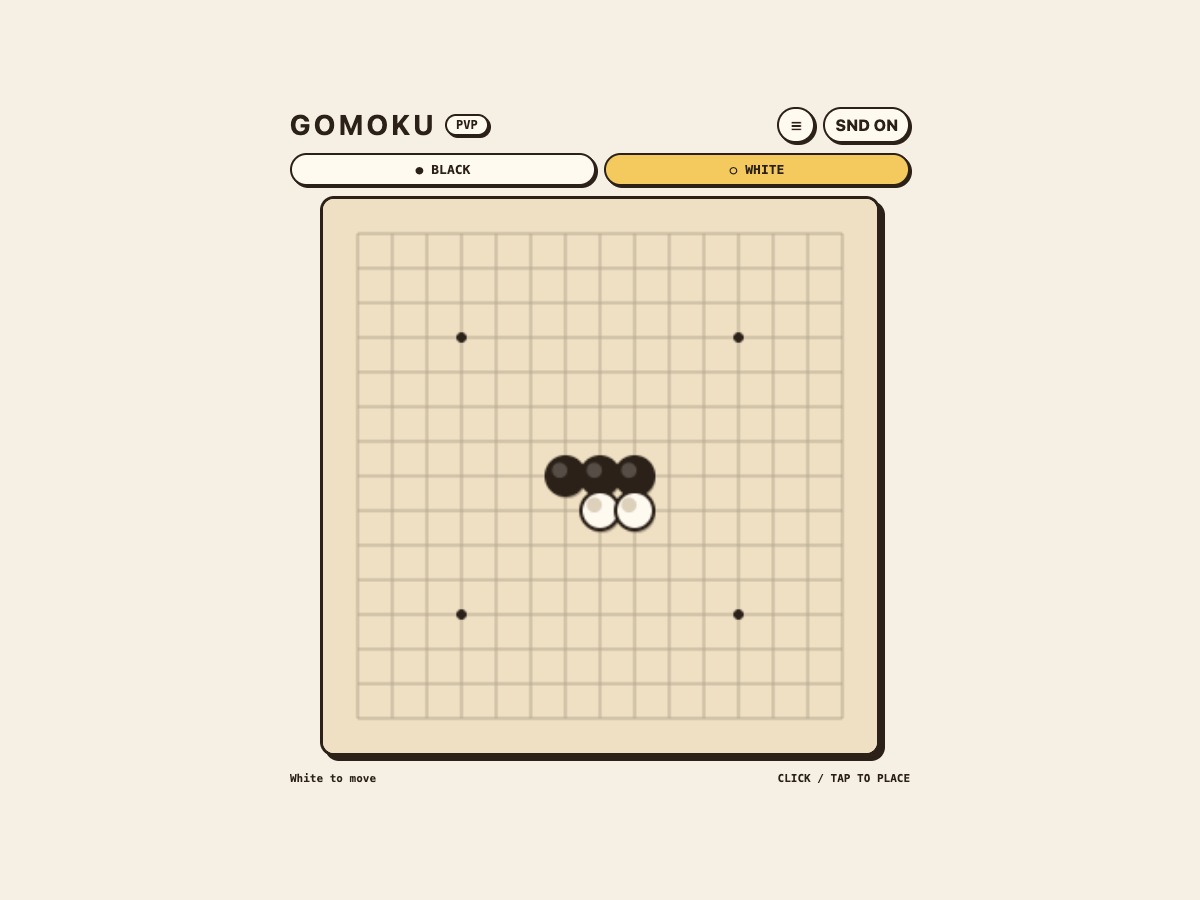
Choose 2 Players when you want both turns to stay on the same device. Click or tap an empty intersection to place the current stone, then let the other player respond. This mode is useful for learning because there is no computer calculation between moves: you can stop and inspect why a position is dangerous before the next stone is placed.
Try a simple exercise in the opening. Let one side build a short line, then have the other side block the most obvious extension. Next, look for a move that does two jobs at once, such as adding to your own diagonal while occupying a point the opponent wanted. Gomoku becomes much clearer when you stop thinking only about your longest line and start comparing the strongest next move available to both sides.
Practice against Easy, Medium, and Hard AI
The menu provides Easy, Medium, and Hard AI. Start with Easy while you are learning basic blocking and line building, then move upward when you can consistently notice immediate four-in-a-row threats. The reviewed runtime performs AI work in a dedicated Web Worker when the browser supports it, keeping the main interface responsive; it also retains a reviewed main-thread fallback path.
Against stronger AI, do not assume every attacking move is automatically best. Before placing a stone, ask what the opponent could complete on the very next turn. If there is an immediate loss threat, block it first. If there is no forced reply, prefer moves that leave multiple possible extensions so a single defensive stone cannot shut down everything you are building.
Use the same rules on desktop or mobile
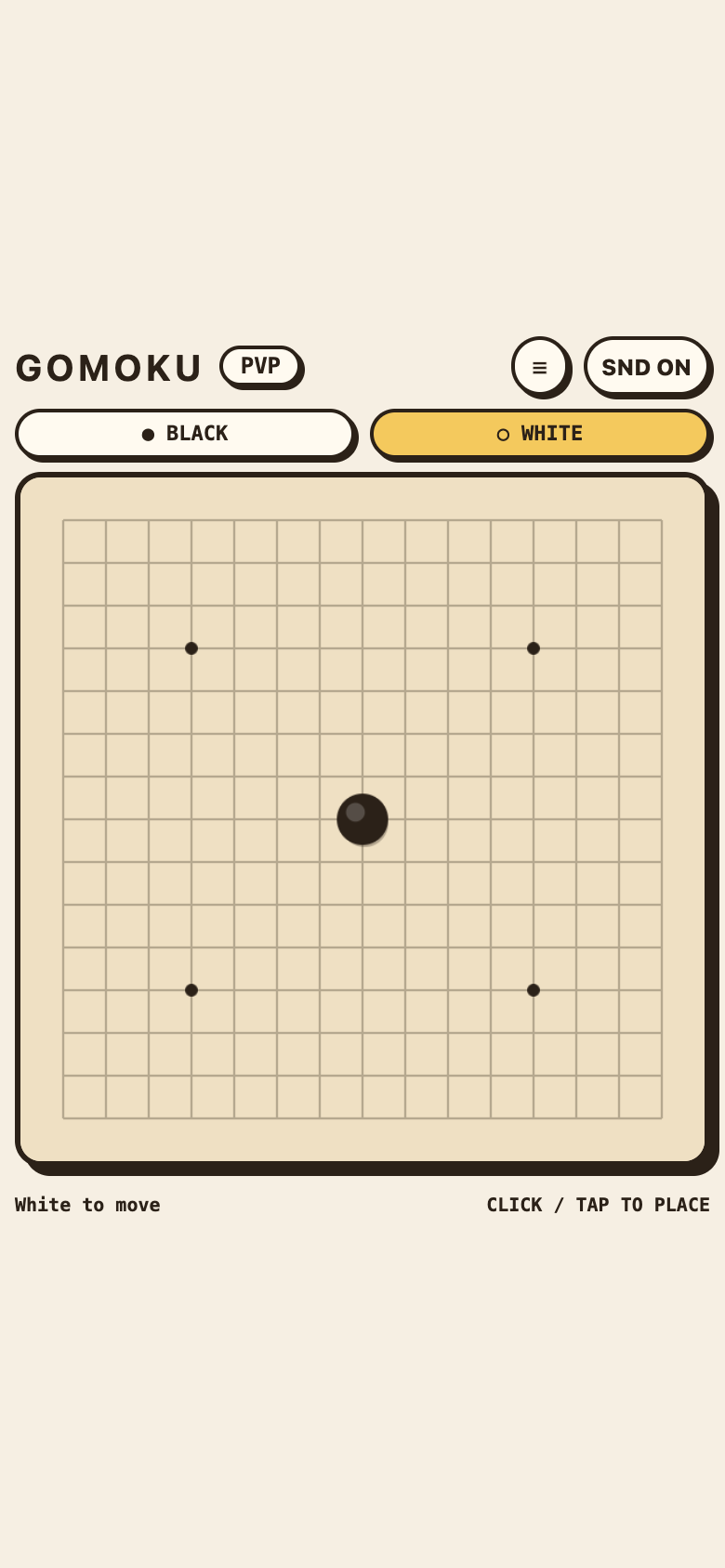
Gomoku is reviewed for desktop and mobile, with mouse, touch, and keyboard capabilities recorded in the library. On touch screens, tap the intended empty intersection carefully and confirm the stone lands where expected before planning the reply. The Portal and Runtime keep the board within the viewport in the reviewed 390×844 portrait and 844×390 landscape checks without horizontal overflow.
Use the menu when you want a fresh board or a different opponent mode. Switching from local play to AI is a good way to test whether a pattern you considered strong actually survives a different response. Because this build is local and self-contained, it should not be described as online multiplayer. Both the two-player mode and the AI matches run in the reviewed browser session without an external game service.
Quick tips
- Scan all four line directions after every move, not just the direction you are currently building.
- Block an immediate opponent win before pursuing a slower attack.
- Use local two-player mode to study positions, then test the same habits against progressively harder AI.