Brickout · 3 min read
Brickout: Paddle Rebounds, Power-Ups, and Faster Waves
Brickout is a paddle-and-ball arcade game. Launch the waiting ball, move the paddle beneath its return path, and break the bricks overhead. You start with three lives, while falling power-ups can widen the paddle, add balls, or change how the next rally works. The goal is to clear the breakable bricks in each formation, then survive the next one. Five formations make a wave, and later waves increase the ball speed.
Play BrickoutLaunch, then follow the returning ball
Move the paddle with the mouse or the Left and Right Arrow keys, then click the playfield, press Space, or choose Launch ball to send the waiting ball upward. On a touch screen, drag to move the paddle and use the launch button. Position yourself under the ball's downward path rather than following every upward movement across the brick field.
Where the ball strikes the paddle affects its return angle. A hit near the middle sends it more directly upward; a hit toward an edge gives it more sideways travel. Start with comfortable central returns, then use angled rebounds to reach bricks that a straight rally keeps missing. Pause when you need a break, and resume before making another movement.
Read normal, tough, and gold bricks
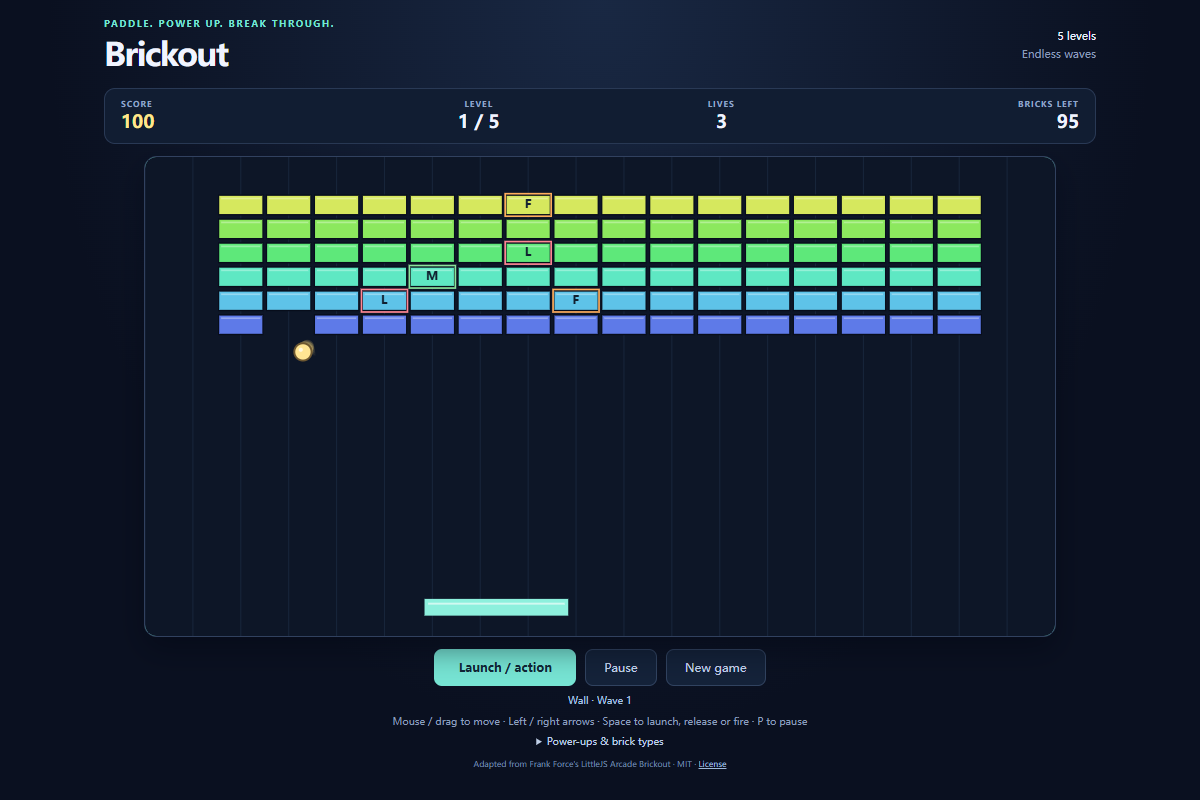
Normal bricks break after one hit. Tough bricks need a second hit, so a rebound that leaves a brick on the screen can still be progress. Gold bricks are solid obstacles: they bounce the ball but are not part of the breakable-brick requirement for finishing a formation.
Breaking several bricks between paddle returns builds a scoring combo. A normal brick starts from 100 points and a tough brick from 200, multiplied by the current combo. The combo resets when a ball returns to the paddle. Opening a path above or behind a formation can produce several consecutive brick hits, but keeping control of the next descending ball still comes first.
Catch useful power-ups without missing the ball
Some bricks release a falling, letter-marked power-up. Catch it with the paddle to activate its effect. W widens the paddle, M adds balls, T makes balls stick to the paddle, and L gives it lasers. F lets a ball burn through breakable bricks, S slows the ball, and 1 adds a life. Sticky, laser, fire, and slow effects are temporary.
A sticky ball waits for another launch action instead of bouncing away immediately. When lasers are active, the action control fires them during play. Multiball gives you more chances to clear bricks, and losing one ball does not cost a life while another remains. Avoid a risky dash after a power-up when the returning ball needs that same stretch of paddle: protecting a life is usually the better choice.
Clear five formations and enter the next wave
The sequence moves through Wall, Pyramid, Castle, Checkerboard, and Gauntlet. Each formation asks you to find a different opening, and the Gauntlet mixes its brick layout. Clearing every breakable brick advances you to the next formation with a waiting serve, giving you a moment to read the new field before launching.
After the fifth formation, the game returns to the first layout and increases the wave number and ball speed. Gold obstacles can remain when a formation is completed. Temporary power effects clear on the transition, so check the current paddle and serve state before assuming the previous rally's tools are still active.
Protect your lives and restart when the run ends
A life is lost when the last active ball drops below the paddle. If lives remain, the game prepares another serve. A missed power-up does not itself remove a life. With several balls in play, track the lowest returning ball first and let the other rebounds continue their work overhead.
Game over arrives when no lives remain. New game begins a fresh run with three lives, zero score, and the first formation. The current run is not saved when you close or reload the game. This is a continuous rally game: Tower Game centers on the instant you drop a floor, while Coil follows a moving trail. In Brickout, read the ball's route between collisions and adjust the paddle before the next return.
Quick tips
- Wait under the descending ball's path instead of chasing it while it travels upward.
- Use edge rebounds to reach a different part of the formation, then return to a safe catching position.
- With multiball, preserve at least one ball; catching a power-up is secondary to protecting the rally.