Number Match · 4 min read
Number Match: Pairing Rules, Clear Paths, Gravity, and End States
Number Match is a single-player clear-the-board number puzzle played on a fixed grid of 12 rows and 7 columns, dealt full with random digits from 1 to 9. Two numbers can be removed as a pair when they are equal or add up to exactly 10—but only if a clear path connects them. Every removed pair triggers gravity: the remaining numbers in each column drop to the bottom, so the board is constantly re-arranging itself. There is no timer, no account, and no way to add new numbers; the game saves automatically in your browser, records your best score, and ends either in a fully cleared board or in an “Out of moves” finish. It plays identically with a mouse on desktop and with touch on a phone.
Play Number MatchPair equal numbers, or two that add to ten
Every move follows the same two-tap pattern: select one number, then select a partner for it. The pair qualifies when the two values are identical (two 4s, two 9s) or when they sum to exactly 10 (1 with 9, 2 with 8, 3 with 7, 4 with 6, 5 with 5). A cleared pair scores 10 points, and the Moves counter tracks how many pairs you have removed.
Selecting a number is safe to explore: the game lights up every position the selected number can reach, so you can see where a match could go before committing. The highlight deliberately shows only geometry, never which value to pick—checking whether a reachable partner actually qualifies is the puzzle. Tapping a non-qualifying number simply moves your selection.
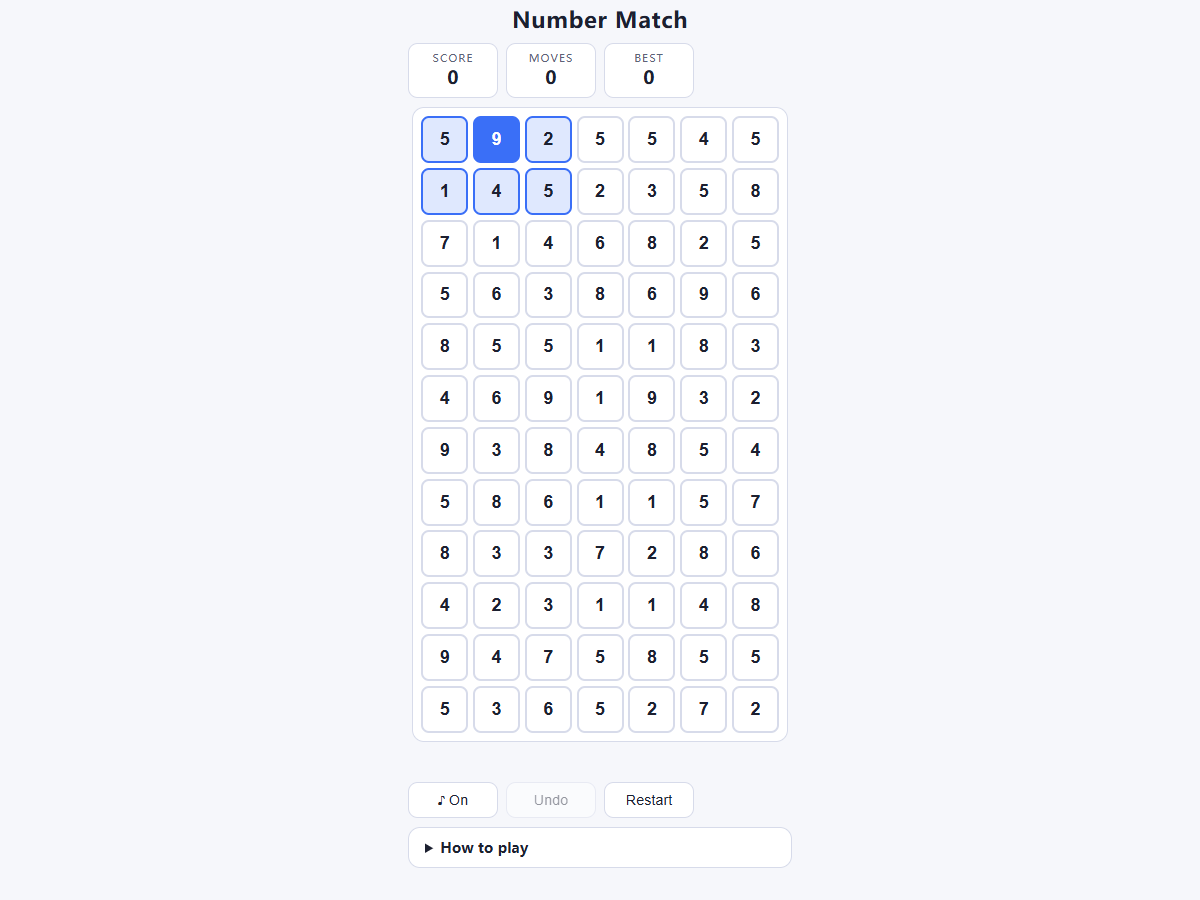
Clear paths and the cross-row reading-order rule
Qualifying values are not enough—the two numbers also need a clear path. A pair connects when they share a row, a column, or either diagonal with only empty cells between them, no matter how far apart they sit. Because cleared cells become empty space, every match you make opens new lines of sight across the board.
The easiest rule to miss is reading-order adjacency. Read the remaining numbers like text, left to right and top to bottom, skipping the holes: two numbers that are next to each other in that sequence can always pair, even when they sit on different rows. That means the last remaining number of one row connects to the first remaining number of the next row, which often rescues a board that looks completely blocked.
Gravity rewrites the board after every match
The grid never grows or shrinks: it is always 12 rows by 7 columns. After each pair is removed, gravity pulls the remaining numbers in every column straight down to the bottom, keeping their relative order, and the freed space collects at the top. Empty columns stay empty.
Gravity means the board you planned around is gone after every move, so re-read it before choosing the next pair. A drop can stack two equal numbers into the same column, line up a sum-of-ten pair on a diagonal, or park a number at the bottom of a column where it becomes a reading-order neighbour of the next row. Clearing low pairs first tends to create the most useful cascades.
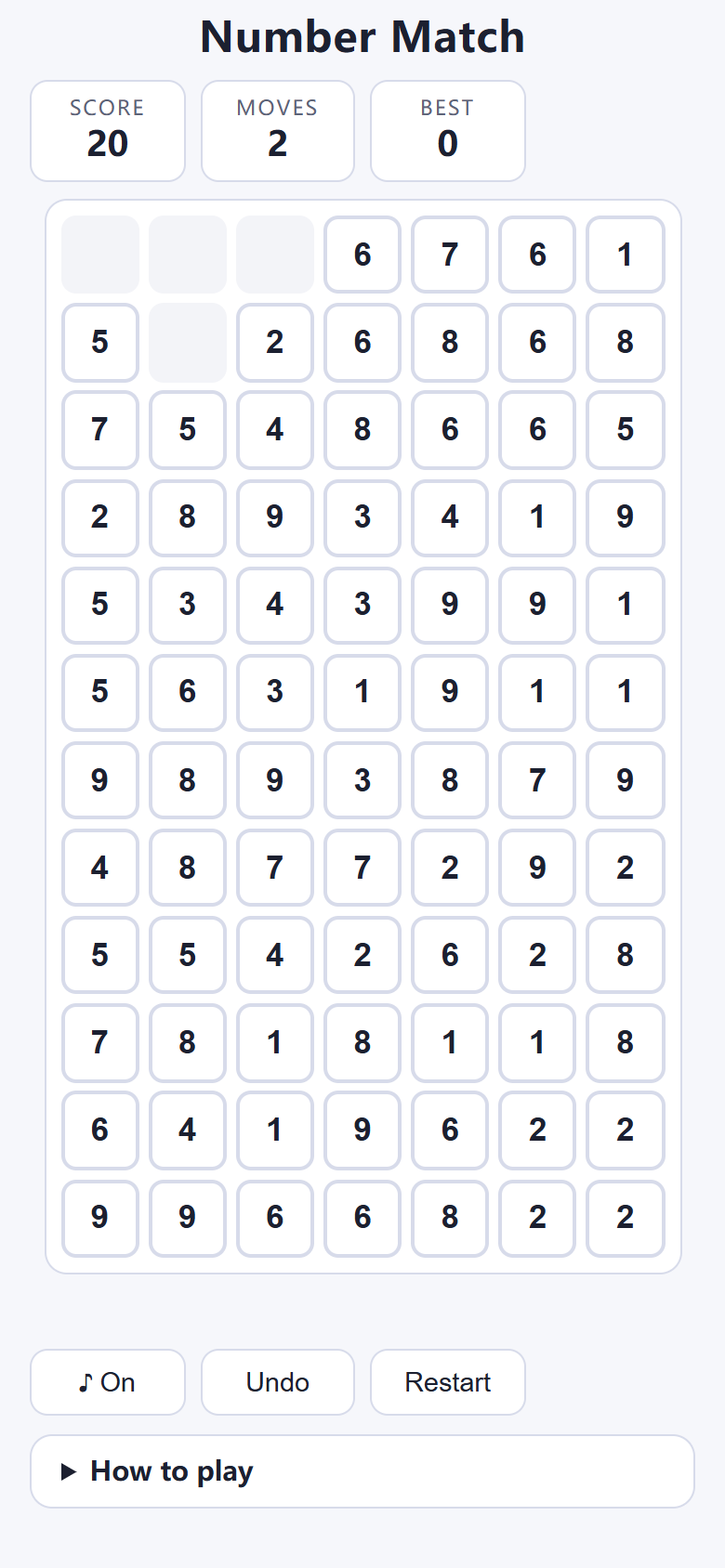
Autosave, best score, and the two end states
Number Match saves automatically in your browser after every move, so closing the tab never costs you a game—reopening the page restores the board, score, and move count exactly, and returning players skip the welcome screen. Your best score is recorded separately and shown in the stats row, and the sound toggle for the synthesized music also persists across visits. Undo takes back exactly one match, restoring the board to its pre-gravity layout, and Restart redeals a fresh full board.
The game ends in one of two ways. Clear every number and you win the board. Run out of legal pairs—no qualifying values with a clear path anywhere—and the “Out of moves” dialog appears with your final score, move count, and best, offering a New Game. Because there is no way to add numbers, every removal is permanent, so treat each match as a small commitment and use Undo the moment a drop closes more paths than it opens.
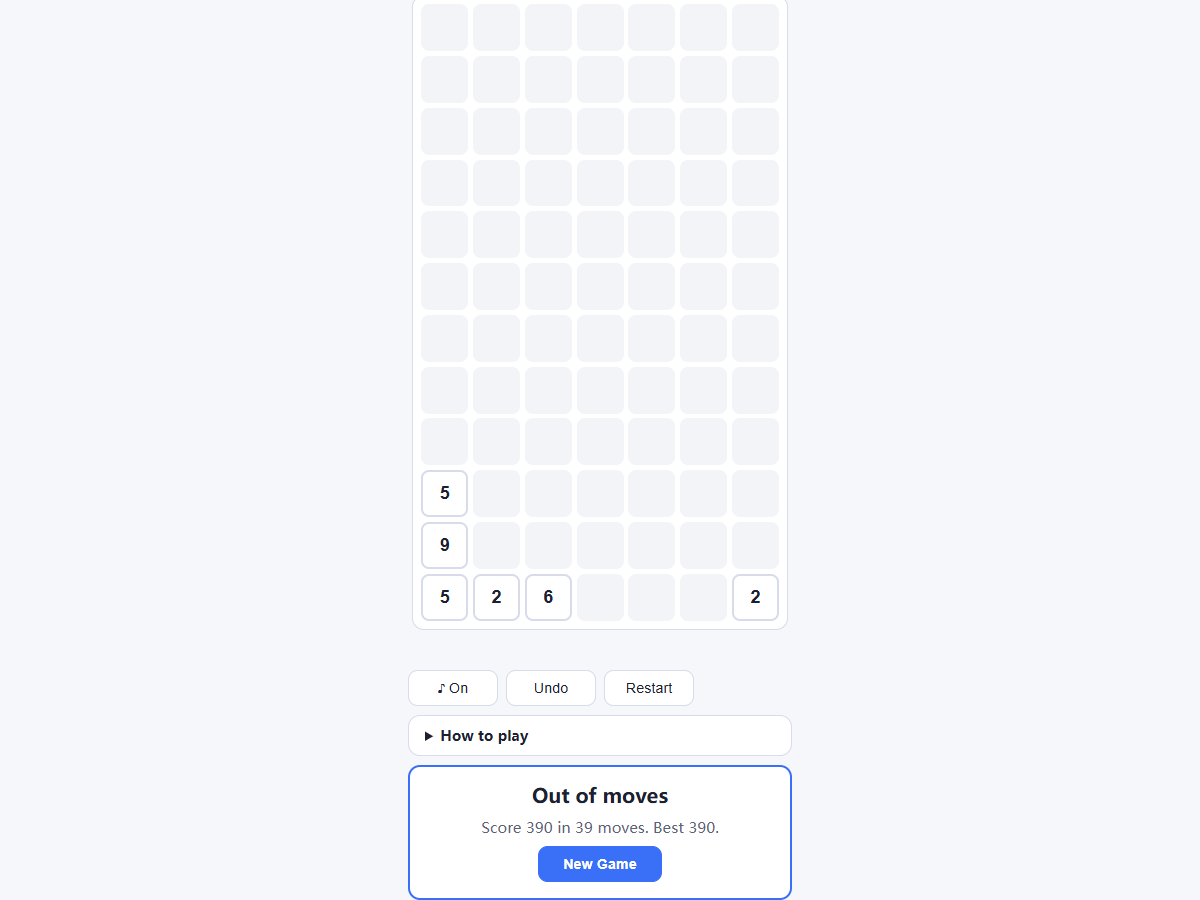
Quick tips
- Pairs qualify on equal values or a sum of 10—memorize the complement pairs (1+9, 2+8, 3+7, 4+6, 5+5) so you can scan faster.
- Remember the reading-order wrap: the tail of a row connects to the head of the next row, which often saves a blocked-looking board.
- Re-read the board after every match; gravity drops each column and can create or destroy lines of sight anywhere.
- Undo restores the exact pre-gravity layout, so test a promising pair and take it back if the drop scrambles your plans.